
After Three Years On the Road, What’s Packed In My Bag?
Clothes are the most extensive and essential packing category for nomads.
They’re also the sneakiest: you buy one t-shirt here, a pair of socks there, and soon your bag is bursting at the seams.
I’ll discuss what’s in my bag and the reasons behind it in this and subsequent articles. I’ll also explain why I left behind certain items that seemed necessary when I bought them.
Note: If you want just the packing list with links, it’s here.
What’s Packed in My Bag Now
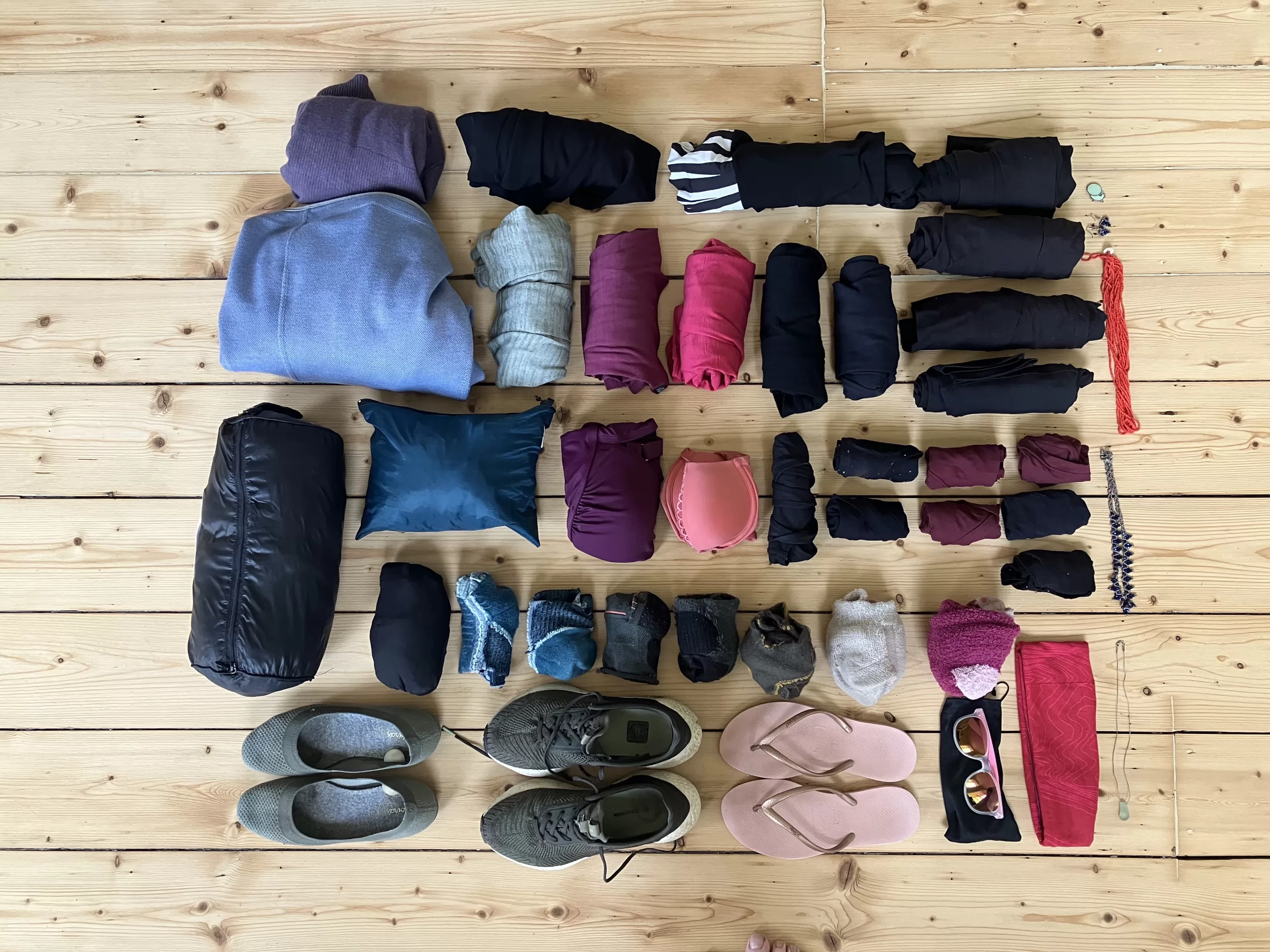
My whole life is in a 35L Pakt clamshell backpack and a smaller Fjällräven daypack. Here’s the clothing in the 35L backpack:
· 3 pairs of leggings
· 3 merino wool t-shirts
· 2 long-sleeved merino wool shirts
· 1 cardigan
· 2 dresses
· 1 longer sweatshirt/hoodie
· 1 puffy jacket
· 1 one-piece bathing suit
· 1 long rain jacket
· 1 pair of rain pants
· 7 pairs of underwear
· 2 bras
· 5 pairs of socks
· 2 buffs
To be clear, my packing strategy is for long-term travel, not for brief trips. Your mileage will vary!
Bottoms

Leggings
Leggings are the best packing strategy for lightweight and compact bottoms if you’re comfortable wearing them often.
They serve as daywear, sportswear, tights, and as pajamas. They’re quick-drying, and if they’re black, they don’t stain.
But they must be comfy.
I’ve searched high and low for leggings that don’t create segmented-worm syndrome, and the key is to find ones without that nasty elastic band (like these). They’re often called “high-waisted.”
If you can’t wear your leggings all day, every day, find another solution. If you insist on jeans, you’ll likely need to wear them on travel days since they’re too bulky to pack.

Dresses
I include dresses in the bottoms category since they cover your legs!
But aren’t skirt and top combinations better? Absolutely. However, I’m willing to forgo that convenience because I’ll do anything to avoid elastic or tightness around my waist. Dresses can serve multiple purposes (as tunics), but skirts are always better from a practical standpoint (mix and match them with tops).
I traveled with two knee-length dresses for a while but discarded the cotton one because it constantly wrinkled.
I replaced it with a maxi dress of the same stretchy, non-lint-forming material as my black knee-length dress: it’s quick-drying, doesn’t shrink, doesn’t stick to you, and has minimal wrinkles. The pattern isn’t my favorite, but it gets the job done and can also be worn as a nightgown or muumuu.
I bought both dresses at thrift shops.
Tops
Short sleeves
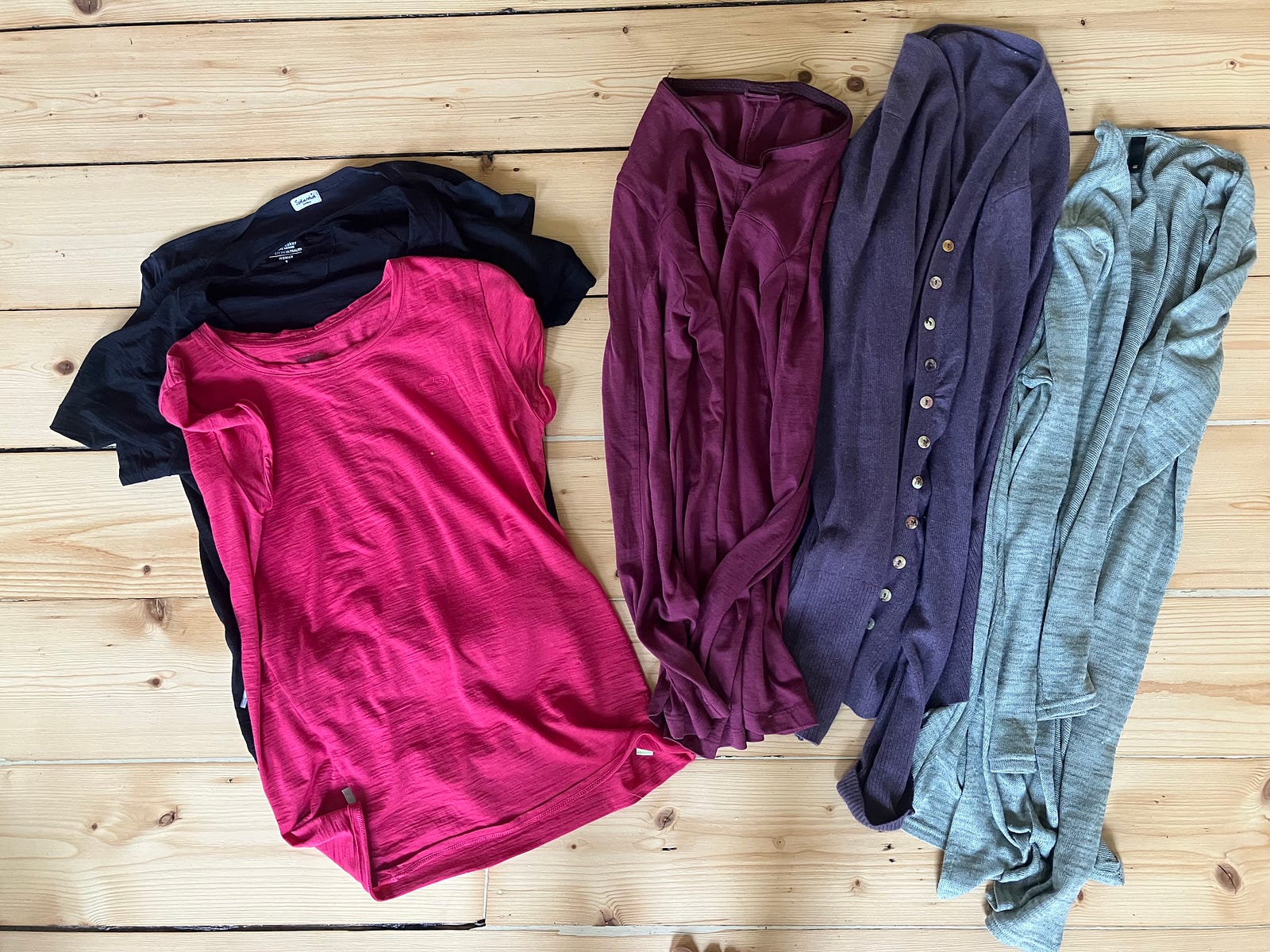
My bag has seen many tops over the past three years. Two are recent purchases: 100% merino wool Icebreaker tops (used) from eBay.
The third is a five-year-old thrifted black cotton top. It’s one of the few shirts I can sleep in, so it doubles as nightwear and backup t-shirt on laundry day. I can wear the merino shirts for three days with vigorous exercise or four without, but the cotton one has to be washed constantly.
While I prefer long-sleeved shirts, these t-shirts are great for layering, exercise, and warmer days.
Long sleeves
Two years ago, I bought a long-sleeved magenta shirt of 70% merino, so I can wear it for at least two days — though not as long as the 100% merino ones.
The cardigan has proved handy. I thrifted it in Zagreb while I was hunting for merino (a favorite charity shop pastime now). I paid $4 for it, so it’s unbeatable from a cost-per-wear perspective. Beyond using it to layer, I also wear it over dresses since my hoodie is often too bulky to wear over a dress. Over time, it’s pilled a bit, so I suspect it’s wool mixed with synthetic material.
Outerwear

Merino hoodie
Before I bought this hoodie, I’d been wearing a boiled wool snap-up jacket for at least six years (also thrifted). I LOVED this jacket/sweater/sweatshirt because it looked elegant and was even more comfortable than living in sweats. And you never had to wash it because boiled wool doesn’t smell. But after multiple repairs on the elbows, I had to let go. Sigh. I still miss it.
At some point, I’d also had a fitted black cotton sweatshirt that was really more like a top. I liked it, but it attracted pet hair and also became smelly almost immediately. I also had a favorite jean jacket — fitted so it took little room — but it also required constant washing. Like a pair of jeans, it was a pain to pack.
I wanted a jacket that was lighter than my down jacket, but still warm enough to keep me comfortable.
This merino hoodie from Giesswein was the most expensive clothing item I’d bought in years. But I figured it’s cost-per-wear would pan out since I would essentially live in it.
Would I buy it again? I’m not sure.
Here are the pros and cons:
Pros
· Merino wool, so you don’t need to wash it all the time
· Warm
· Keeps its shape
· Pockets, zipper, and a hood
Cons
· The white zippers become discolored over time
· Pills a little
· Feels itchy (I’m not convinced that it’s actually merino)
· Pretty heavy, so it’s not that easy to pack
Ideally, I’d find the same boiled wool jacket I’d had before or a true merino hoodie that’s lighter and less itchy (I can tell when I put on the hood).
Long down jacket
Repeat purchase! I bought the same jacket from Mountain Warehouse in 2020. I love it because it’s very packable, snug (I like snug jackets), has a hood and is water resistant. Its length also helps keep me warm and cozy.
The downside (pun intended) is its synthetic filling: not as breathable or squishable as down. Would I prefer down? Yes, but most long down jackets are expensive, and I’d worry about damaging them.
Rain Gear

Rain jacket
I’ve had MANY false starts with rain gear, largely because I needed to buy it online during lockdown (because we were in Cornwall…so rain gear was essential).
I tried regular cheap rain jackets, but they had two problems. One is length. A short rain jacket over my long down jacket still meant I was soaked from the waist down. Not good.
Second, cheap rain jackets don’t breathe properly, so the jacket’s inside can sweat…and then it becomes pointless to wear it.
I found a long rain jacket that’s more breathable, though it’s still bulky. But I spend a lot of time in rainy weather, so it’s worth it for me. If you don’t, or don’t enjoy walking in the rain, then don’t buy a rain jacket — or at least buy a tiny fold-up one.
Side note: I’ve given up on umbrellas. Most climates I’m in often have wind with rain, so umbrellas become pointless. Besides, if I’m going on a long walk for exercise, it’s a pain to carry an umbrella.
Rain pants
On the topic of rain, I have rain pants! Since I walk a lot, it’s worth it to me…though I do have a periodic urge to bin them.
I also had false starts with rain pants. I’ve settled on this pair of lightweight, roll-up-into-a-ball rain pants. Though I don’t use them often, I have also used them as snow pants in Croatia over my leggings.
Socks and Underwear

7 pairs of underwear
Focus on finding materials that meet the criteria of comfort, drying time, and durability.
2 bras
I have one regular and one sports bra. You could have just one, depending on how much you use them.
5 pairs of socks
I’ve stowly replaced all my socks with merino wool/synthetic combo versions. Cotton socks are terrible. Once a pair starts to wear out, I’ll use them as houseslippers.
Tip:
Because my feet are small, I find the length of socks to be ridiculous — they often come up to my knee. I also don’t like the compression feeling on my calves, so I cut off the tops: now they’re ankle socks!
I recommend ankle socks not only because of this compression issue, but also because they take up less room in your luggage. If unavailable, cut off the tops and tolerate unraveling. It’s fine.
Bathing suit
For almost a decade, I wore the same bathing suit. Once it disintegrated, I bought one online in Italy because we were still in lockdown. I was pleased with the results but didn’t realize how bulky it was! I’m not a bikini girl, but if you are, I recommend you buy a bikini over a one-piece suit because (a) it’s smaller, and (b) it can double up for other purposes.
Buffs

Merino wool buffs double as headbands and scarves. I really only need one, but I can’t seem to let go of the second one — maybe because it takes up so little space. They can also work as an eye mask in a pinch.
Tip:
Consider the color. If you go with neutral colors for your clothing, find a colorful buff.
What I Gave Up
Here are the items I traveled with but gave up…eventually.
Tights: Useless and uncomfortable
I carried around my favorite black tights for almost two years and didn’t use them once (this was also when I had tall boots). If you wear leggings, tights become useless and uncomfortable.
Cotton items: Not versatile enough
As you’ve gathered by now, I’m a complete merino wool convert. I hesitated for a long time about this (thank you, Seva) because regular wool makes my skin itch. A lot.
I didn’t realize how soft, thin, and breathable merino wool is. I suggest you buy one 100% wool piece and try it out for a while. Because it’s so expensive (even used), you can gradually replace your other clothing items with it.
Corduroy, Velvet, Strange Synthetics: Material that attracts lint
Corduroy, velvet, and unknown synthetic materials attract pet hair and lint. When combined with dark clothing, it’s impossible to go out looking half-decent as a house sitter unless you invest your life savings in unsustainable lint remover sheets.
It’s fine if you live in one spot, but if you’re a full-time traveler — and especially a housesitter — you’ll give up on these materials quickly. They’re just not worth the trouble.
Hat: Itchy and single-use
I gave up on my hats because they make my head itch. Even if you don’t have this problem, you might forgo a knit hat (assuming you’re traveling in a cold climate) if you have a hoodie and a buff that can double as a makeshift hat.
This one isn’t a big deal because it’s so small, but you know how these things can add up.
Gloves
I’ve had regular knit gloves and fingerless gloves. I have cold hands, so I find even insulated fingerless gloves tend to just keep them cold. If have regular gloves that warm my hands, they’re still not worth it because it’s hard to use a phone and do other daily tasks in them.
Here are two alternatives:
- Use your heavy jacket to warm up your hands by pulling it over the base of your hands.
2. Buy long-sleeve tops with thumbholes (I have one), so you can wear it and have magical fingerless gloves right there!
Of course, if you’re in a snowy climate, you may just buy a cheap pair of gloves, especially since they take little space.
Things you’re considering…but shouldn’t
Slippers
Slippers are a great idea in principle: they keep your feet warm, clean and cut down on your socks’ wear and tear.
Buying slippers with a structure of some sort is out because it’s like packing another pair of shoes. But you might be tempted to buy special sock-like slippers.
While they’re alluringly cozy, avoid the temptation. Get thick socks that can be used as both socks and slippers.
Scarves
Many packing blogs recommend scarves as a marvelous double-up option: they can be warm, dress up your outfit, and even be used as blankets in a pinch.
For short-term trips, this is sage advice. However, for long-term traveling, I find them useless. You soon let go of trying to wear different outfits as a long-term traveler — you’re not going to the office every day, after all.
Better, smaller, and more versatile options for warmth include a buff.
Although it can function as a blanket, you can also use your other clothing for warmth on an overnight train, for example.
I love scarves, but you’ll soon find it’s better to let them go.
In the next article, we’ll review the bane of your packing existence: shoes.
Happy packing!